7. What was fixed, and why it matters
Every problem found in ASYNCH during 2026, how serious it was for someone using the model, and what changed. Each item also has a short "C lesson" for readers learning the code.
The full technical record is chapter 8, and every change is in the changelog.
4
critical issues fixed
12
high-severity issues fixed
0
reference files modified
119
automatic tests (C + Python)
7.1 How every change was checked
Two comparisons are made after every change to the code:
Against the results shipped with the original ASYNCH repository (
examples/results/,examples/more/*/results_benchmark/). These reference files are never modified. They are the benchmark.Against the original code itself, run on the same inputs. With one processor, an unchanged result must be identical to the last digit; only a change that is meant to alter results may differ, and then the difference is measured and explained.
On top of that, special builds of the program that stop at the first memory error (the “sanitizers”, chapter 9) run every example. Chapter 9 explains how to repeat all of this yourself, with one command.
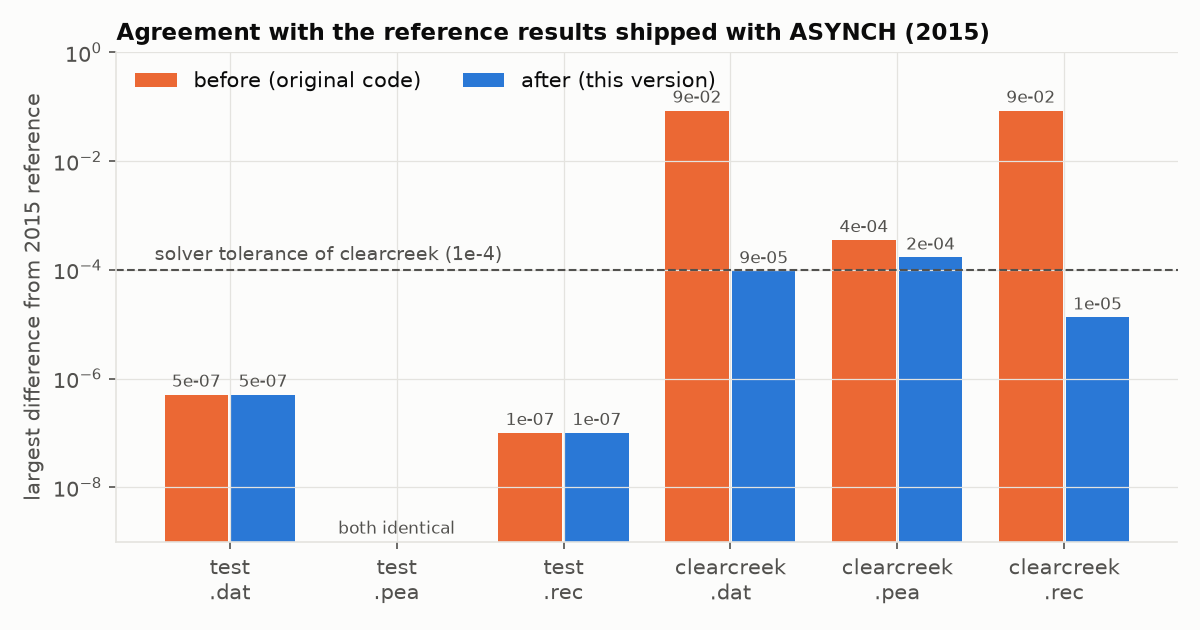
The figure below summarises the outcome against the six reference files of 2015: the orange bars are the original code, the blue bars this version. Lower is better; below the dashed line means “within the solver’s accuracy”.
7.2 How serious is a bug? The four classes
Class |
Meaning for a user of the model |
|---|---|
Critical |
Can give wrong numbers without any warning, or crash, with standard settings or the shipped examples |
High |
Wrong numbers, a crash or an endless run in a documented option or a plausible setup; or results lost without being told |
Medium |
A crash with an obvious cause, or differences far too small to matter hydrologically |
Low |
No effect on results: messages, warnings, tidiness of the code |
A “silent” error is always worse than a crash: a crash is noticed, a wrong number is not.
7.3 Overview
Area |
Issue |
Class |
Status |
|---|---|---|---|
Model equations |
B-28: five models evaporated ponded water 1000 times too fast (since 2015) |
Critical |
fixed |
Model equations |
B-29: model 255 turned channel storage into 8 to 15 times too much discharge (since 2022) |
Critical |
fixed |
Numerical solver |
B-13: solver methods 0 and 1 computed with random numbers |
Critical |
fixed |
Memory / outputs |
B-01: the main example overwrote memory; crashed on one processor |
Critical |
fixed |
Model equations |
S-02: model 254 baseflow forced to 0 by a line added in 2021 |
High |
fixed (original equation restored) |
Model equations |
B-30: models 258 and 259 computed the baseflow from the evaporation total |
High |
fixed |
Model equations |
B-31: model 249 mixed m³/min and m³/s in its baseflow |
High |
fixed |
Inputs |
B-12: missing initial values were taken from random memory |
High |
fixed |
Numerical solver |
B-14: per-link solver settings ( |
High |
fixed |
Outputs |
B-15: a missing output folder lost all results, yet the run “succeeded” |
High |
fixed |
Network |
B-16: a junction with more than 8 upstream streams crashed the run |
High |
fixed |
Model equations |
B-23: models 263, 601, 602, 603 read parameters from outside their memory |
High |
fixed |
Inputs |
B-25: rain from binary (radar) files: the last file almost ignored, crashes, memory overflow |
High |
fixed |
Library / Python |
B-20: user-defined outputs of some states were written as 0 |
High |
fixed |
Model equations |
B-26: models 105 and 263 took some of their values from leftover memory |
High |
fixed |
Python |
A-01: the Python interface did not work at all |
High |
replaced (chapter 10) |
Model equations |
B-34: models 225 and 601–609 gave “not a number” when the hillslope was completely dry |
Medium |
fixed |
Outputs / models |
B-32, B-33, B-35: an evaporation total 720 times too large, a wrong area in peak files, a derivative left unset |
Low |
fixed |
Models |
B-24: 7 model numbers without equations crashed; solvers of one program shared tables |
Medium |
fixed |
Library |
B-17: library functions that crashed with built-in models, or were missing |
Medium |
fixed |
Inputs |
B-18: dam models could start in the wrong regime when read from an |
Medium |
fixed |
Library |
B-06: programs using ASYNCH as a library got a wrong link count above 65 535 links |
Medium |
fixed |
Numerical solver |
B-04: an invalid solver number crashed the program |
Medium |
fixed |
Outputs |
B-02: snapshots depended slightly on the number of processors |
Medium |
fixed |
Program end |
B-03: debug versions crashed at the very end |
Medium |
fixed |
Examples |
two examples pointed to a computer at the University of Iowa |
Medium |
fixed |
Memory |
B-05, B-07, B-08: freeing the wrong memory, a leak, misaligned reads |
Low |
fixed |
Messages |
B-09, B-10: debug text printed at every step; compiler warnings |
Low |
fixed |
Code |
B-19, B-21, B-22: an unused out-of-range read, a filter applied to the wrong model, a typo multiplied by 0 |
Low |
fixed |
Memory |
B-27: a check read memory that was never written (no effect on results) |
Low |
fixed |
7.4 The critical issues
B-28: five models evaporated ponded water 1000 times too fast
Critical fixed
What happened. The Top Layer models share the potential evaporation (read from the evaporation file) between three stores of water: water ponded on the surface, the top soil and the deeper soil. The three parts must add up to the potential evaporation. In June 2015 a change titled “fixed evaporation bug in models” multiplied the part taken from the ponded water by 1000, in every Top Layer model of the time. New models were later written by copying these ones, so the factor spread. It was removed one model at a time over the years (from model 254 in April 2020), but never everywhere: models 257, 258, 259, 261 and 262 still had it.
Why it matters. Whenever water was ponded, it evaporated up to 1000 times faster than it should, more than the potential evaporation itself. Ponded water is what becomes surface runoff, so these models gave too little runoff and flood peaks that were too low, without any warning. Model 254 results from every release up to 1.4.3 had the same error.
Now
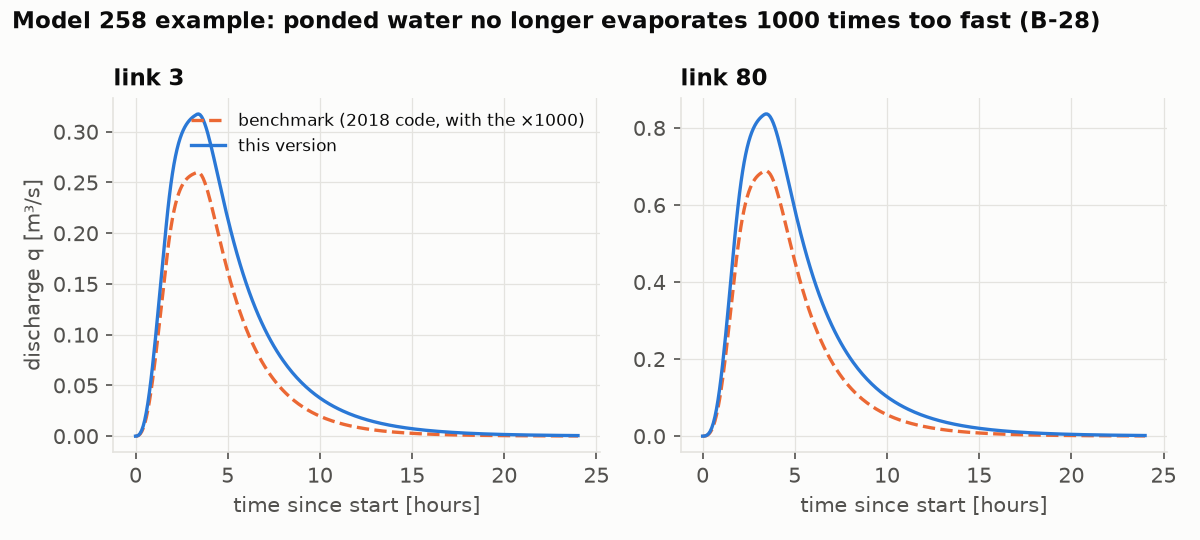
The factor is removed. A new test checks, for 15 models, that the evaporation taken from the three stores adds up exactly to the potential evaporation; it fails on the old code for exactly these five models. In the model 258 example the outlet peak rises from 0.69 to 0.84 m³/s (figure). The reference results of this example were produced with the error, so they are kept unchanged and the difference is recorded as intended.
C lesson
A number written in the middle of a formula (a “magic number”) says nothing about its unit. Checking the units of
every term (m, m/min, m³/s) is what showed that 1e3 could not belong there.
B-29: model 255 turned channel storage into far too much discharge
Critical fixed
What happened. Model 255 keeps the water stored in each channel and computes the discharge from it. In July 2022, in a change titled “changes to model 402”, the correct formula was commented out and replaced by one of the wrong form, whose result is not even in m³/s.
Why it matters. For the same water in the channel, the discharge was 8 to 15 times too large (the larger the basin, the larger the error): flood waves travelled much too fast. The start of each run was also inconsistent, because the initial storage was computed with the correct formula.
Now
The correct formula is restored. A new test converts a discharge to a storage and back, for the three models that work this way; it fails on the old code only for model 255.
B-13: solver methods 0 and 1 computed with random numbers
Critical fixed
What happened. ASYNCH offers three numerical methods (the %Numerical solver index in the .gbl):
0 = RK 3(2), 1 = RK 4(3), 2 = Dormand–Prince 5(4). Each method is defined by a small table of fixed
coefficients. For methods 0 and 1 these tables were stored in a temporary place in memory that is
released as soon as the setup is finished. Every time step then read whatever happened to be in that place.
Why it matters. Results computed with method 0 or 1 by earlier versions of ASYNCH are unreliable:
the run either computed with meaningless coefficients, or never finished (the test example ran forever
in most attempts). Method 2, which all examples use, stores its table correctly and was never affected.
Now
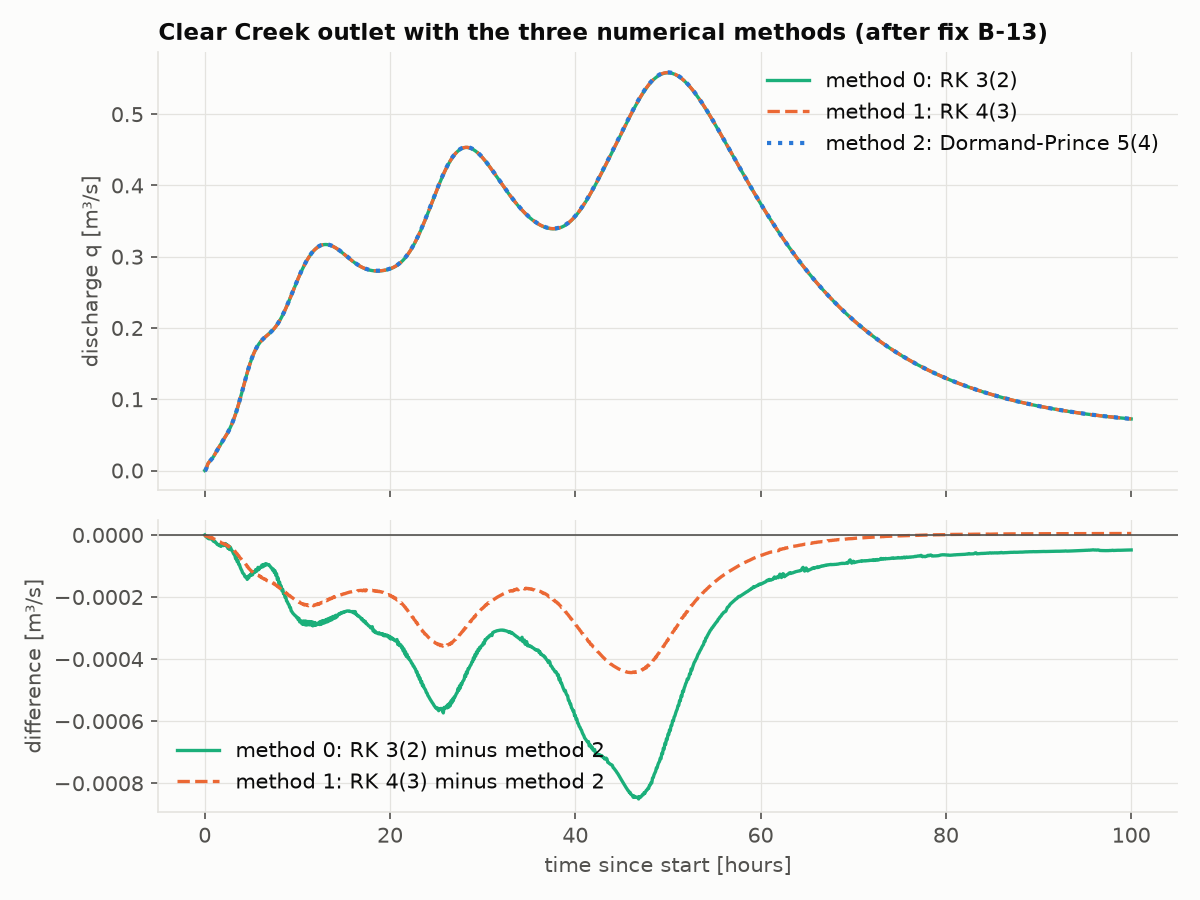
The three methods run and agree with each other as they should (figure below: the curves overlap; the lower panel shows that the differences stay below 0.00085 m³/s, which is 0.15 % of the peak).
C lesson
A variable declared inside a function lives only
while the function runs. Keeping its address afterwards is a “dangling pointer”. The fix was one word, static,
which makes the table live for the whole program. (see 6.6)
B-01: the main example overwrote memory
Critical fixed
What happened. When writing a snapshot, model 254 used a filter written for model 256, which has
one more state. For each link it touched one number more than exists, writing into the neighbouring link’s data,
and for the last link past the end of the memory reserved for the file. The cause was a single missing word,
break, in the list of models.
Why it matters. Runs of model 254 that write snapshots, such as the larger example clearcreek.gbl, crashed on one processor. On several processors it
seemed to work, but memory was being overwritten, which can corrupt results in ways that cannot be predicted.
Now
Runs on any number of processors. The fix itself changed no result: on two processors, all 27 output files were identical to the original’s. (Model 254 results changed later, on purpose, with S-02 below.)
C lesson
In C, a switch keeps
running into the next case until it meets break. (see 6.7)
7.5 The high-severity issues
S-02: model 254 baseflow forced to zero
High fixed
What happened. Model 254 tracks, besides the total discharge, the part of it that comes from
groundwater (baseflow, state q_b). In January 2021 one line of the model was changed, inside a code change titled
“added model 194”, so that the channel always lost baseflow as if there were at least 0.001 m³/s of it. When there
was less, the model removed water that was not there, and the baseflow was pushed to zero. This line is not part of
the published model or of its documentation.
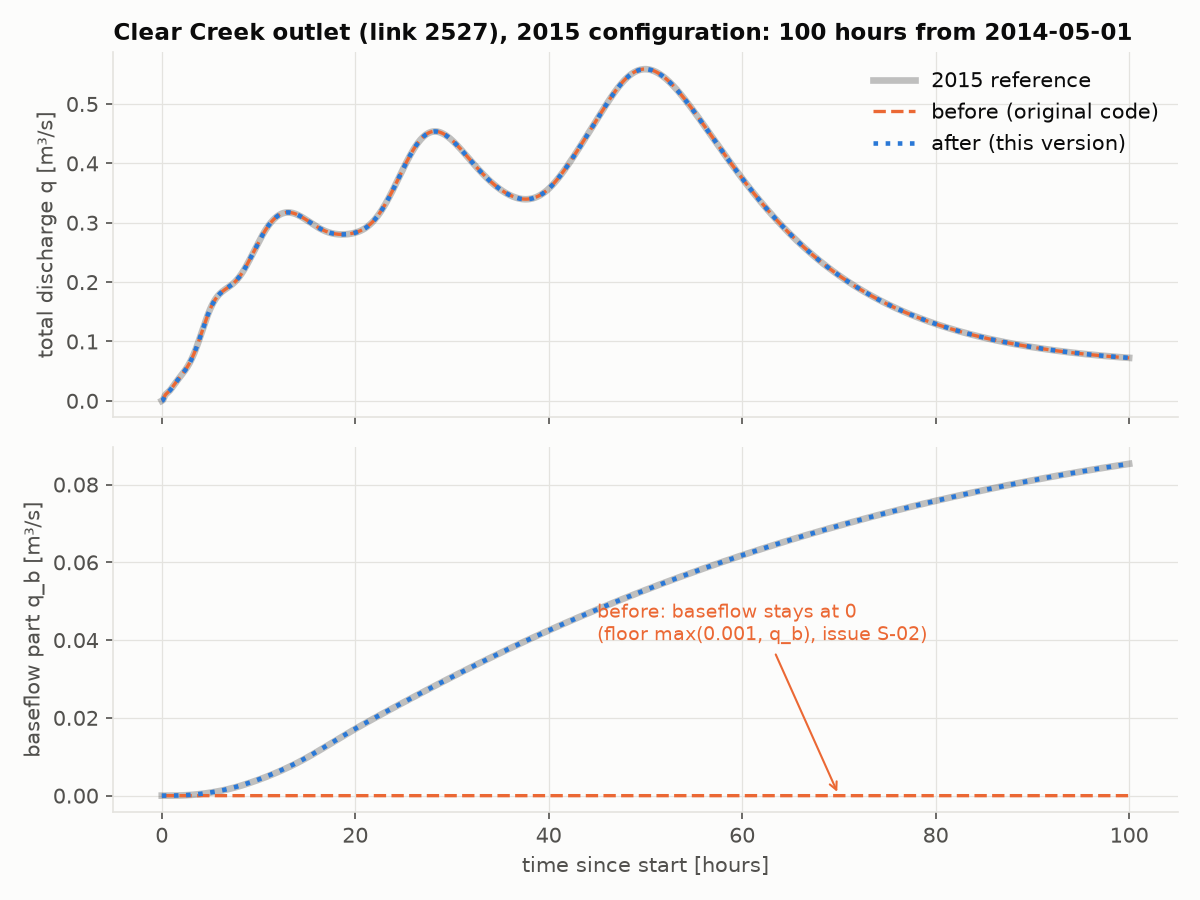
Why it matters. Over the 100-hour Clear Creek run, the reference baseflow at the outlet rises to 0.085 m³/s. The 2021 code kept it at 0 for the whole run: a 100 % error on that output. The total discharge was almost unaffected (at most 0.0003 m³/s), because in this model the baseflow state is bookkeeping: it reports how much of the flow is baseflow, and does not feed back into the total. Anyone using the baseflow output of model 254 since 2021 was affected.
Now
The original equation is restored (decision of the model owner). The reference results shipped with ASYNCH are reproduced within the accuracy of the solver.
B-30 and B-31: baseflow of models 258, 259 and 249
High fixed
What happened. Models 258 and 259 keep the running total of evaporation in state 6 and the baseflow in state 7, but their baseflow equation read state 6, and passed state 6 downstream. Model 249 added baseflow in m³/min to baseflow in m³/s, a factor 60 apart; its version for links with a reservoir also printed two lines at every step.
Why it matters. The baseflow outputs of these models were meaningless. Their total discharge did not use them and was not affected.
Now
Each model reads its own baseflow state, in one unit (m³/s). A test checks that the baseflow of 258 and 259 no longer depends on the evaporation total and that the upstream baseflow reaches the link.
B-12: missing initial values taken from random memory
High fixed
What happened. The initial-state file (.uini) gives one starting value per state. If it gave fewer values
than the model needs, ASYNCH did not notice, and the missing states started from whatever was in memory.
Why it matters. It happened in the shipped examples: models 258 and 259 need 4 values, but their file gives 3, so the subsurface storage started from random memory. By luck that memory was 0; on another computer it may not be.
Now
Missing values are 0, a warning says so, and a mismatch between the model number in the file and in the
.gbl is reported.
C lesson
Reading functions report end-of-file with a special value, which must be checked. (see 6.8)
B-14: per-link solver settings never worked
High fixed
What happened. The .rkd option (a file giving tolerances and method for each link) is part of the documented
input format. Reading it contained five separate mistakes, the first being an endless loop: the program never got past
“Reading dam and reservoir data…”.
Now
Rewritten and tested: a file that repeats the global settings for every link gives results identical to the
normal run, and a faulty file stops with a clear message. The format is now documented and has an example (examples/test.rkd).
B-15: results silently lost when an output folder was missing
High fixed
What happened. If a folder named in the .gbl for the outputs did not exist, ASYNCH computed the whole
simulation, printed Error: could not open ... lines while writing, and then reported success (exit code 0)
without having written any results. Scripts and operational chains that run ASYNCH check that exit code, so the
missing results went unnoticed. It was found while testing the exercise of chapter 2.
Now
Every output folder is checked before the computation starts, and a missing or read-only folder stops
the run at once with a message naming it. If writing still fails at the end (a full disk, for example), asynch
ends with an error code.
C lesson
A program tells whoever started it whether it succeeded through its exit
code (the value returned by main, 0 = success). Printing an error is not enough.
B-23: four models read parameters from outside their memory
High fixed
What happened. Each link keeps its parameters in a small table. For models 263, 601, 602 and 603 the table was
declared one or two places shorter than the number of values the model reads from its parameter file. The last
value was written just past the end of the table, into memory that belongs to something else, and the model then read
it back from there (model 263 even read two values that were never stored: v_B and k_tl).
Why it matters. The results of these models depended on whatever happened to be in that memory: they could be right by luck, change from one computer to another, or crash. Nothing warned. None of the shipped examples uses these models, which is why it went unnoticed; a new unit test that checks the sizes of every model found it.
Now
The tables have room for every value. Model 263 needs 16 values per link in its parameter file (it used 16 in its equations all along).
B-25: rain from binary files
High fixed
What happened. Operational runs often read rain from a series of binary files, one per time step (e.g. radar
rainfall every 5 minutes); the global file says which files to use, from number first to number last. The reader
asked for one file more than that range. If the folder held exactly the declared files, the program crashed (or, for
compressed files, stopped). If it held one more, the run went on, but the rain of the file last was applied for
0.0001 minutes instead of a full time step. In some configurations it also wrote past the end of its memory.
Now
Exactly the declared files are read, the last one applies for its full time step and then the rain is 0, as the documentation says. A missing file stops the run with its name. Tested: the same rain given as a text file and in the three binary formats gives identical results.
B-20: user-defined outputs could be written as 0
High fixed
A program (or now a Python script) can add its own outputs, computed from the states of a link. The solver must be told which states such an output uses, so that it computes them at the output times. The code did the opposite of what it meant: it added the states that were already computed, and skipped the others, which were then written as 0. Tested: an output of the surface storage of model 190 was 0 at every time, instead of values around 0.001 m.
B-26: two models took values from leftover memory
High fixed
What happened. A model tells the solver how fast each of its states changes. Models 105 and 263 did not do it for all their states (model 105 for its storage, model 263 for four of its eight states), so the solver used whatever numbers were left in its working memory from an earlier computation.
Why it matters. The results of these two models were not defined: they could differ from one computer or one run to the next, and a run could become extremely slow. This is how it was found: one run of the tests did not finish, in the middle of the loop over all models. No example uses these models.
Now
The states without an equation keep their starting values, so every run gives the same numbers. What the authors meant these states to do is an open question for a hydrologist (S-07, chapter 8). A new check in the unit tests makes sure that every model sets every state; it found exactly these two models.
7.6 Medium and low issues, in brief
B-34 (Medium): models 225 and 601–609 divided by the total water on the hillslope to share evaporation; on a completely dry hillslope this is a division by zero, and the run produced “not a number”. Now there is simply no evaporation from an empty hillslope. A new test runs every model on a dry hillslope.
B-32, B-33, B-35 (Low): model 257’s evaporation total was converted with the rain factor (720 times too large); peak-flow files of the oldest models wrote the area in km² × 10⁻⁶; model 606 left one derivative unset when its tile storage was empty.
Model 249 with reservoirs (B-36) does not work and is recorded for its author; several other questions about the units and constants of rarely used models (S-08 to S-12) are listed in chapter 8.
B-04 (Medium): a solver number other than 0, 1 or 2 (the
.gblcomment even suggested 3 and 4) crashed the program. It now stops with a message listing the valid values.B-02 (Medium): snapshot values below 10⁻¹² were set to 0 only for links computed by the first processor, so snapshots differed slightly with the number of processors. Now the same rule applies to every link.
B-03 (Medium): the output file was closed twice at the very end, which crashed “debug” versions of the program (results were already written). Fixed.
Examples 258/259 (Medium): pointed to a file on a University of Iowa computer, so they could not run anywhere else. They now use the evaporation file shipped in the repository. Model 258 reproduced its reference exactly until 1.6.0; since the evaporation fix (B-28) it differs on purpose.
B-16 (High): at a junction, ASYNCH keeps the data of every upstream stream in a list with room for 8. The file reader accepted up to 10, and a junction with 9 or 10 upstream streams overwrote memory at every time step, which crashed the run. Now one limit of 16 applies everywhere, and a network exceeding it is refused with a clear message.
B-06 (Medium): the function that reports the number of links used a type that stops at 65 535. A 70 000-link network was reported as 4 464 links. It only affected programs that use ASYNCH as a library, such as the Python API.
B-24 (Medium): seven model numbers (200, 260, 300, 301, 315, 607, 2000) have sizes but no equations in ASYNCH; choosing one crashed at the first step. They are now refused with a message. Also, the tables of the numerical methods were shared by every solver of a program: harmless for the
asynchprogram (one solver), wrong for a Python script that creates several.B-17 (Medium): functions of the library used by other programs (such as the Python package) crashed with the built-in models, or did not exist although declared.
B-18 (Medium): for models with dams, the initial “regime” (e.g. whether a spillway flows) was stored on the wrong link when the initial state came from an
.inifile.B-19, B-21, B-22 (Low): model 190 read a third forcing that does not exist, into a variable it never used; custom models received the snapshot filter of the built-in model with the same number; a wrong constant in a formula that is only ever evaluated where it is multiplied by 0.
B-27 (Low): when a link used the values of its upstream links, a safety check also looked at values that had never been computed. Those values were never used, so results did not change; the working memory now starts at 0.
B-05, B-07, B-08 (Low): memory handling errors that did not change results: freeing the wrong address, a buffer never released, numbers read from misaligned memory addresses.
B-09, B-10 (Low): models 402 and 403 printed a debug line at every step; compiler warnings about a missing declaration and a wrong print format.
7.7 Python, and tests for everything
The Python interface of the original ASYNCH could not work any more (issue A-01: Python 2, not built, and it assumed a memory layout that had changed). It is replaced by a new package, described in chapter 10. What it changes for a user:
a simulation can be run, stopped, inspected and changed from a Python script (states, parameters, outputs);
new models can be written in Python, as C code that is compiled automatically (as fast as the built-in models) or as Python functions (slower, no compiler needed);
global files and input files can be created from Python.
How we know the package is right: the files it writes are identical to those of the asynch program, byte for byte;
models 190 and 191 rewritten through it give exactly the numbers of the built-in models; and simple models with a known
exact solution (a chain of linear reservoirs) are reproduced to better than 1e-8.
make check now runs three sets of tests (chapter 9): 23 C unit tests, 73 tests of the Python package, and all the
examples against their reference results. The C unit tests check, among other things, the coefficient tables of the
three numerical methods against the textbook conditions (a check that would have caught B-13) and the setup and equations
of every built-in model; with the Python tests (52 models run a short simulation; rain in four file formats) they
found B-22 to B-25. Together they run two thirds of the lines of the C code (chapter 9).
7.8 Tools added along the way
tests/regression/run_examples.py: runs every example and compares every output with the references and, optionally, with the original code (chapter 9).examples/test_2015.gbl,examples/clearcreek_2015.gbl: the configurations that produced the 2015 reference results, recovered from the repository history and translated to today’s format.tools/python/asynch_io.py,tools/python/plot_hydrographs.py: read and plot the outputs (chapter 2).tools/python/make_comparison_plots.py: regenerates the figures of this chapter.Dockerfile: a tested, ready-made environment (chapter 1).